

The Blue Paper:
Upgrading the Rendering Engine (Tau vs. Pi)
If the Red Paper is your mental firewall, the Black Paper is your new OS, and the White Paper is the network architecture, the Blue Paper is the core rendering engine. It dictates how your brain actually visualizes cycles, waves, and systems.
For generations, the mathematical rendering engine of the world has been running on a slightly glitched constant: Pi (π). The Blue Paper explains why we need to patch this with a new constant—Tau (τ)—and how that simple fix completely rewires your brain to think in full systems instead of broken fragments.
The Glitch in the Original Code (π)
Everyone knows Pi (π approx 3.14). It’s defined as the ratio of a circle’s circumference to its diameter. But here is the glitch: in physics, geometry, and computer graphics, the fundamental building block of a circle isn't the diameter; it's the radius (the distance from the center point to the edge). Think of a spawn point or a radar pulse in a video game—it radiates outward from a center point.
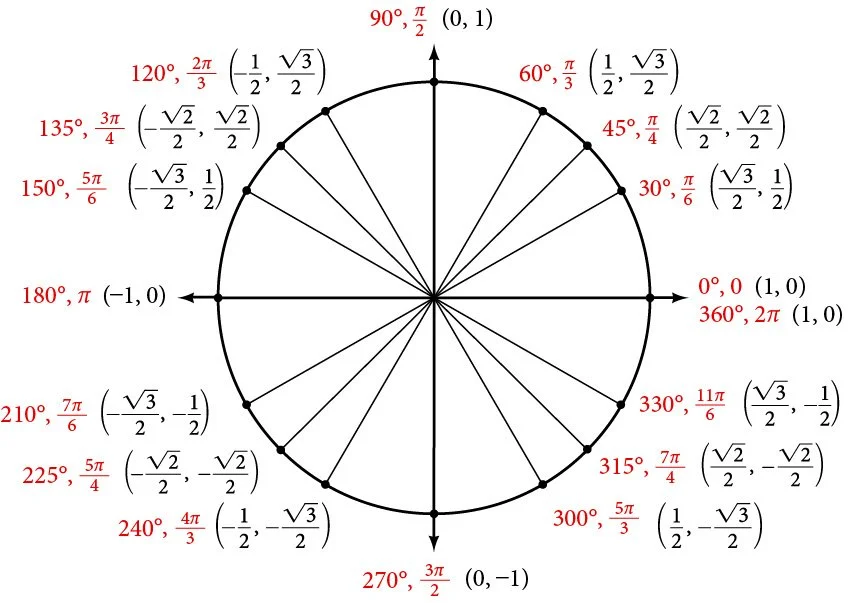
Because Pi is based on the diameter, it’s structurally a half-measure. When you measure angles in radians using Pi, a full 360-degree rotation is 2π. A half-rotation is π. It forces your brain to constantly multiply or divide by two just to understand where you are on the map. It adds unnecessary lag to your mental processing.
The Tau Patch (τ)
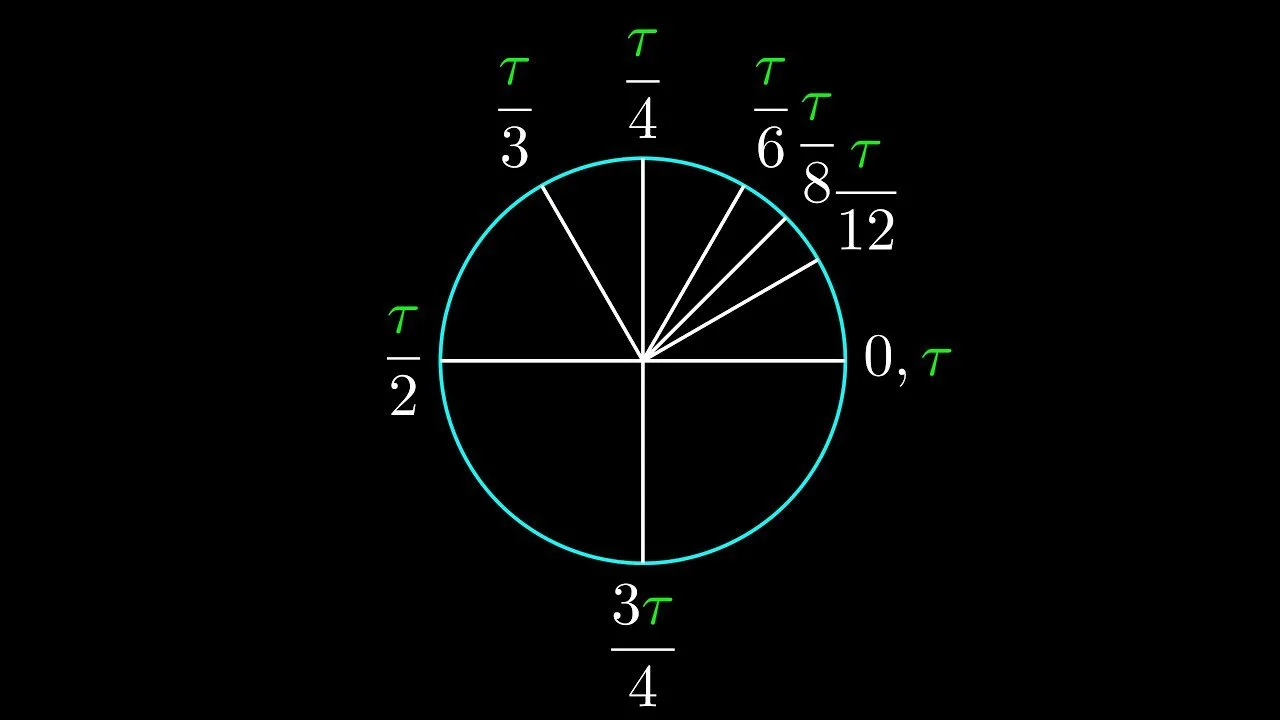
The Blue Paper advocates for standardizing Tau (τ approx 6.28$), which is simply 2π. Tau is the ratio of a circle’s circumference to its radius.
By defining the constant this way, one full rotation is exactly τ.
A half-rotation is τ/2.
A quarter-rotation is τ/4.
The fractions match exactly what you are seeing. You don't have to memorize a clunky translation table; the math directly matches the visual geometry.
Streamlining the Math Formulas
When you apply the Tau patch, the most important equations in physics and math suddenly clean themselves up, dropping the confusing, extra factors of two.
Area of a Circle: Instead of A = πr², it becomes A = ½τr². This isn't just a cosmetic change. It perfectly aligns the geometry of a circle with the physics equation for kinetic energy (K = ½mv²) and the formula for distance involving acceleration (d = ½at²). You start to see the universal rhythm.
Euler's Identity: The famous complex number equation e^iπ = -1 is celebrated, but it only calculates a half-rotation. With Tau, the equation completes the cycle: e^iτ = 1. It brings the system all the way back to the starting point, creating a perfect loop.
The Tutorial Level: Reducing Cognitive Load
As this new PHYSIX framework rolls out to Louisiana high school classrooms, the goal isn't just to make students better at a math test. The goal is to clear up your "working memory."
Educational research shows that when students are forced to constantly convert units and deal with fragmented equations, their "extraneous cognitive load" maxes out. They spend all their brain power just trying to read the formula, leaving no energy to actually understand the science. Tau makes trigonometry and wave physics native to how you already think. It treats periodicity (things that repeat in cycles) as a first-class concept.
The Cultural Shift: Wholes Over Fragments
The Blue Paper goes beyond just math; it’s a conceptual metaphor for how we view the world.
When you are trained to measure the universe in half-cycles and fragments, you start seeing society in fragments (which feeds right back into the binary, "us vs. them" mindset from the Red Paper). By upgrading your mental engine to Tau, you train your brain to look for full cycles, completeness, and interconnected systems.
You stop looking at isolated events and start seeing the feedback loops, equilibrium, and structural harmony of the entire map. That is what it means to truly level up your systems-thinking.