

The International Fixed Calendar
Calendar Correction:
A Proposal for Enhanced Temporal Precision
The Zynx Calendar Correction is a structured reform of traditional calendars, promoting consistency, astronomical accuracy, and efficiency through ‘Mass Mental Manipulation’.
Part of Zinx Technologies' pedagogical ecosystem, it integrates NASA and JPL standards to eliminate drifts in dates, weekdays, and seasons.
The Zynx Calendar Correction represents a systematic reformulation of the conventional calendar framework, designed to achieve greater consistency and operational efficiency. Developed within the Zynx Securities ecosystem—a pedagogical initiative under Zinx Technologies—this model addresses historical inaccuracies in timekeeping by integrating principles from astronomy, mathematics, and metrology. It draws upon established standards from organizations such as NASA and the Jet Propulsion Laboratory (JPL) to mitigate drifts in dates, weekdays, and seasonal cycles.
Core Architecture:
Months: Twelve standardized months of 28 days (four weeks), with "Sol Months" extending to 29 days in standard years and 30 in leap years, forming a 348-day base.
Seasons: Four 91-day seasons (13 weeks), comprising three 28-day months plus a transitional week, aligned to equinoxes and solstices.
Year Completion: Adds one New Year's Eve Day to reach 365 days, ensuring fixed weekday-date alignments.
Leap Year Integration
Cycle: Years 1–3: 365 days; Year 4: ~365.9644 days with an extra Leap Day applied to the final month's 30th day.
Refinements: Incorporates VLBI measurements and quantum clocks (e.g., 2012 leap second), following Gregorian rules (omit leaps in non-400-divisible centuries) for an average 365.2425-day year with 0.0003-day error.
Basis: Addresses Julian excesses (0.0078 days/year) and tropical year metrics (365.2422 days).
Foundations and Benefits
Grounded in UT/UTC protocols and historical reforms (e.g., 1582 Gregorian shift), it outperforms prior models like 13-month calendars by preserving seven-day weeks.
Advantages include perpetual scheduling stability, seasonal fidelity, and educational utility via AI tools in the Zynx platform.
Fundamental Structure
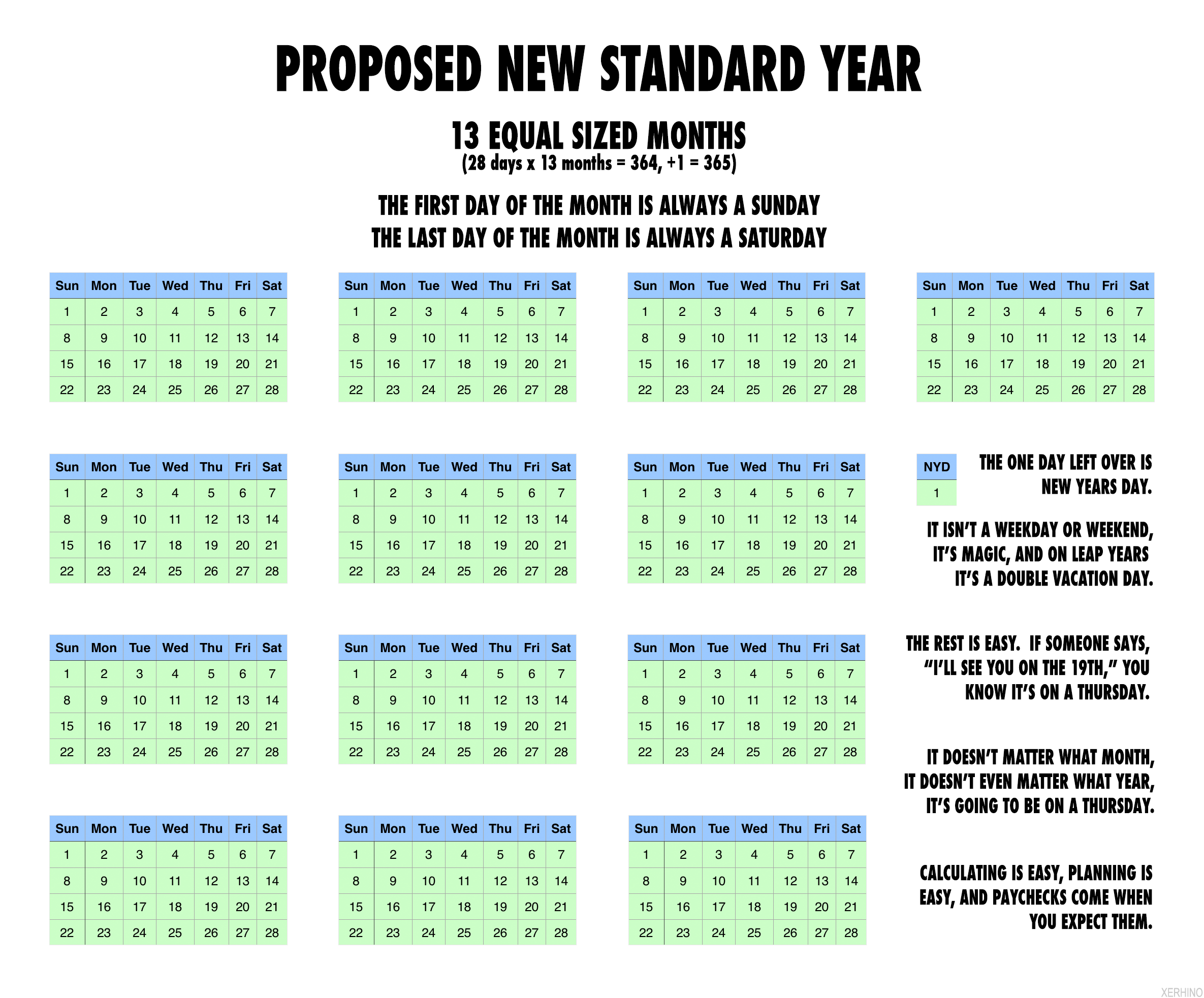
The proposed calendar is anchored in a 364-day base year, comprising exactly 52 weeks, ensuring uniformity across annual cycles. Key components include:
Months: Twelve months, each standardized to 28 days (equivalent to four precise weeks). However, the system incorporates "Sol Months" that extend to 29 days in standard years and 30 days in leap years, yielding a foundational 348 days (12 × 29) with supplementary adjustments to align with the solar year.
-Seasons: Four equitable seasons, each spanning 91 days (13 weeks). This is achieved through three 28-day months (84 days) augmented by one transitional week (7 days), facilitating alignment with key astronomical events: the vernal and autumnal equinoxes, and the summer and winter solstices.
Annual Completion: To approximate Earth's 365-day orbital period, a single additional day—designated as New Year's Eve—is appended beyond the seasonal structure.
This architecture ensures fixed weekday assignments for all dates, eliminating the variability inherent in traditional systems where dates shift relative to days of the week.
Leap Year Mechanisms
To accommodate the Earth's actual sidereal year of approximately 365.2422 days, leap years are implemented quadrennially, with refined corrections for rotational and orbital variances:
Cycle Overview:
Years 1–3: 365 days each.
Year 4 (Leap Year): Approximately 365.9644 days, incorporating one additional Leap Day alongside the standard New Year's Eve Day.
Precision Adjustments**: The leap correction is applied to the 30th day of the final month, synchronizing with empirical data on Earth's rotation. This includes provisions for fractional increments, informed by NASA's quantum clocks and Very Long Baseline Interferometry (VLBI) measurements, such as the leap second insertion on June 30, 2012.
Long-Term Calibration**: Adheres to Gregorian-style rules, omitting leap days in century years not divisible by 400 (e.g., 1900 omitted; 2000 included), resulting in an average year length of 365.2425 days with a minimal error margin of 0.0003 days per annum.
Scientific and Historical Foundations
The correction is grounded in rigorous astronomical metrics:
Orbital Dynamics: Utilizes JPL ephemerides for solar year calculations, addressing the tropical year (365.2422 days) and mitigating discrepancies from the Julian Calendar's overestimation (0.0078 days per year excess).
Time Standards: Integrates Universal Time (UT) and Coordinated Universal Time (UTC) protocols, referencing historical reforms such as the Gregorian Calendar's introduction in 1582 to correct accumulated drift.
Empirical References: Incorporates data from authoritative sources, including NASA Goddard Space Flight Center's rotational studies and external analyses from platforms like timeanddate.com.
This approach contrasts with prior unsuccessful proposals, such as 13-month calendars, by prioritizing compatibility with existing seven-day week structures while enhancing precision.
Objectives and Advantages
The primary objective is to establish a "virtually perfect" calendar that simplifies scheduling, educational applications, and global coordination. Benefits include:
Perpetual alignment of dates and weekdays, reducing administrative complexities.
Enhanced seasonal fidelity, minimizing equinoctial and solstitial deviations.
Pedagogical value, serving as an interactive framework for exploring timekeeping concepts via AI-assisted tools within the Zynx ecosystem.
As a conceptual model, the Zynx Calendar Correction emphasizes intellectual accessibility and innovation, aligning with Zinx Technologies' mission to democratize complex scientific knowledge. Further exploration can be pursued through affiliated platforms, such as Zynx.Online and the Leap-Gras event which is the cross section of the Solar, Gregorian Calendar and the Lunar Cycle.
Applications of Zynx Theory
Zynx Theory, a speculative framework reinterpreting fundamental physics from first principles, extends beyond theoretical constructs to practical applications across multiple domains. It emphasizes simplification through natural units and discrete models, facilitating intuitive understanding and interdisciplinary integration. Below is a structured exploration of its key applications, derived from associated resources.
Educational Applications
Zynx Theory serves as a pedagogical tool designed to enhance accessibility for autodidacts and educators. By reorganizing complex scientific data into intuitive modules, it supports self-directed learning in fields such as physics, mathematics, artificial intelligence, and game theory. For instance, concepts like the Distance-Time Identity (D = c × t, with c = 1) and Wave Balance (1 = Frequency × Wavelength) are employed to demystify dense equations, aligning with resources from institutions like Khan Academy and MIT OpenCourseWare for retraining on foundational principles. This approach promotes modular knowledge delivery, such as through "instruction of knowledge" frameworks that integrate AI-assisted stress testing for conceptual verification.
Physics and Cosmology Applications
In physics, Zynx Theory applies Sphere Expansion Theory to redefine gravity as tension arising from discrete "sphere updates" in universal expansion, rather than a traditional force. This discrete time model, with the speed of light as a ratio (c = D/T = 1), enables unified descriptions of phenomena like wave-particle duality and harmonic states via the N-Axis (an integer ratio tracking cycle states across spatial and temporal parameters). It advocates Tau (τ = 2π) over Pi for quantum cycles, simplifying equations in cosmology and quantum mechanics. Practical implications include advanced coordinate systems (e.g., Geocentric Earth Inertial for inertial tracking) for modeling orbital dynamics and magnetospheric studies.
Artificial Intelligence and Technology Applications
The theory integrates with AI through an "AI sandbox" for stress testing, where linguistic hierarchies (via Linguistix) encode and translate complex concepts for machine processing. This supports applications in language models and computational simulations, ensuring logical consistency in AI-driven educational tools. In technology, redefined units facilitate efficient data manipulation, potentially aiding secure systems design under Zynx Securities' autodidactic security frameworks.
Game Theory and Logical Systems Applications
Zynx Theory applies game-theoretic principles by modeling logical systems through formal derivations and recursive rules, preserving truth in simulations of human resources and societal dynamics. It links to binary political systems (Politix) and forces of social change (Civix), providing a basis for analyzing strategic interactions in economics and civics.
Broader Implications and Limitations
Philosophically grounded in axioms like "Limits are fabricated by mentality," Zynx Theory fosters resilience in learning and innovation, with potential extensions to linguistics for hierarchical communication. While speculative and lacking empirical validation, its modular ecosystem (Physix for laws, Logix for rules) positions it as a versatile tool for interdisciplinary advancement. Future applications may expand to real-world simulations, though current documentation emphasizes conceptual education over deployed technologies.
NASA’s Leap Second:
If the day seems a little longer than usual on Saturday, June 30, 2012, that's because it will be. An extra second, or "leap" second, will be added at midnight to account for the fact that it is taking Earth longer and longer to complete one full turn—a day—or, technically, a solar day.
"The solar day is gradually getting longer because Earth's rotation is slowing down ever so slightly," says Daniel MacMillan of NASA's Goddard Space Flight Center in Greenbelt, Md.
Scientists know exactly how long it takes Earth to rotate because they have been making that measurement for decades using an extremely precise technique called Very Long Baseline Interferometry (VLBI). VLBI measurements are made daily by an international network of stations that team up to conduct observations at the same time and correlate the results. NASA Goddard provides essential coordination of these measurements, as well as processing and archiving the data collected. And NASA is helping to lead the development of the next generation of VLBI system through the agency's Space Geodesy Project, led by Goddard.
BackgrounD JPL Math:
The length of a year is based on how long it takes a planet to revolve around the Sun. Earth takes about 365.2422 days to make one revolution around the Sun. That's about six hours longer than the 365 days that we typically include in a calendar year. As a result, every four years we have about 24 extra hours that we add to the calendar at the end of February in the form of leap day. Without leap day, the dates of annual events, such as equinoxes and solstices, would slowly shift to later in the year, changing the dates of each season. After only a century without leap day, summer wouldn’t start until mid-July!
But the peculiar adjustments don't end there. If Earth revolved around the Sun in exactly 365 days and six hours, this system of adding a leap day every four years would need no exceptions. However, Earth takes a little less time than that to orbit the Sun. Rounding up and inserting a 24-hour leap day every four years adds about 45 extra minutes to every four-year leap cycle. That adds up to about three days every 400 years. To correct for that, years that are divisible by 100 don't have leap days unless they’re also divisible by 400. If you do the math, you'll see that the year 2000 was a leap year, but 2100, 2200 and 2300 will not be.
NASA Calendar Corrections:
The tropical year is the period of time required by the sun to pass from vernal equinox to vernal equinox. It is equal to 365 days, 5 hours, 48 minutes, and 46 seconds, or 365.2422 days. The tropical year is used to keep track of seasons, planting, and harvesting. Let's try to develop a calendar with an integral number of days per calendar year that will keep track of the tropical year and not get out of step with the seasons over time.
We begin with a calendar of 365 days per year. Our calendar year is shorter than the tropical year by 0.2422 days. So to correct (approximately), we add 1 day every four years (leap year). Thus, three calendar years are 365 days long; the fourth calendar year is 366 days long. The average length of the calendar year in days now becomes: (3 x 365 + 366)/4 = 365.25 days.
This calendar system was actually instituted for use in the Roman Empire by Julius Caesar around 46 BC. But since the Julian calendar was 0.0078 days (11 minutes and 14 seconds) longer than the tropical year, errors in timekeeping gradually accumulated. Between 46 BC and 1582 AD, this accumulated error amounted to a total of: 0.0078 x (1582 + 46) = 12.7 days. In 1582, Pope Gregory XIII reformed the calendar by specifying that all years divisible by 4 are to be leap years except for century years, which must be divisible by 400 to be leap years. Now, in 1200 years:
A total of 300 years (including all century years {since any century year = N x 100, where N = an integer}) are divisible by 4, and are therefore candidate leap years.
A total of 900 years are not divisible by 4, and are therefore regular years.
Twelve century years are possible leap years.
But only 3 century years (out of the 12) are divisible by 400 (i.e., {400, 800, 1200}, {1600, 2000, 2400}, etc.), so only 3 century years are actually leap years9 .
Since 12 - 3 = 9, Gregory's rule eliminates 9 leap years out of 1,200. Thus: 300 - 9 = 291 years are actual leap years, and 900 + 9 = 909 years are regular years. The average length of the year becomes (291 x 366 + 909 x 365)/1,200 = 365.2425 days, with an error of 365.2425 - 365.2422 = 0.0003 days per year, or one day every 3,333.3 years.
The Gregorian calendar came into use in Roman Catholic countries in October 1582 when the seasons were brought back into step by eliminating 10 days from the calendar then in use. Thursday, October 4, was followed by Friday, October 15 (which caused some consternation among the populace, especially those with birthdays on the eliminated dates!). Britain and its colonies did not introduce the Gregorian calendar until September 1752 by which time an additional one day correction was required (actually, {1752 - 1582} x 0.0078 = 1.33 day). Some British documents from the period before the British reform actually contain two dates, an old and a new.